The Art Of The Offer

Image

credit: blogginf4jobs.com

You may have recently seen my last post, targeted directly at first-time homebuyers (and others who are unfamiliar with the real estate transaction process).  Click this link to check out Step 4, if you haven’t read it yet.

I thought it might be helpful to dedicate this post to a part of the homebuying process which is often misunderstood:  The offer.  Folks have many misconceptions about how the process works, and I wanted to address and clarify some of them in the interest of making you better-prepared when you sit down to figure out the details of Step 4.   

The first thing I want you to understand about this entire situation is that there is a real, live, flesh-and-blood person at the other end of the negotiating table.  If your offer insults them before the two of you have even met, the likelihood of your offer getting picked over others is immediately very slim.  You are not negotiating with “the Manager,” that faceless “guy behind the curtain” at a car dealership, whose only purpose is to make you think you’re getting a deal while he puts the screws to you.  You are trying to make a legitimate trade with a person who may or may not have decades of emotional attachment to his/her home.  Obviously, the point of your offer is to pay the least amount for the home, or in many cases, get the maximum amount of help with closing costs (an out-of-pocket expense) that you can — but if the offer isn’t anywhere near being fair, they may not even give you the chance to play ball.

The primary details of an offer are few: the Earnest Money Deposit (or EMD check), the settlement date (your timeline to move in), the home inspection, the amount of money you are willing to pay for the house, and the closing costs.  Lets start with the EMD check.

The Earnest Money Deposit is basically an indicator to the seller of how badly you want the house.  It is an amount of money that will be submitted with the accepted offer, which sits in a separate account until the end of the transaction, when it will be returned to you.  Here’s the catch:  If you decide 25 days after your offer is accepted that you simply don’t want the house anymore because you found a better one, you will lose your EMD money to the sellers, who will take it as compensation for you not holding up your end of the bargain.  And don’t forget, once settlement day comes around and the contract is wrapped up, you get that money back and can put it toward whatever you want.

So, the size of the EMD amount is very telling of how badly you want the home.  A common amount to submit is 1% of the purchase price, but that number is completely up to you.  The EMD effectively tells the seller how much money you are willing to lose if you cut and run.  An EMD amount of five hundred bucks won’t instill much confidence in your offer to the seller.  You would want some “insurance” against a breach of contract too, wouldn’t you?

The other negotiable parts of the offer will come down to one word:  Leverage.  The next thing you and your agent will do is poke your nose around for things that can be used as leverage to negotiate on the price of the home.  If the home is in obvious need of a new roof, but the asking price hasn’t been adjusted for it, you have the leverage you’d need to ask the seller either to fix it or drop the price.  If you know the seller is up against a deadline and needs to move as soon as possible (or if the property is vacant), and you can move in tomorrow, you can use the settlement date as leverage to get your offer chosen over others which may be competing with yours for attention.  If you are in a buyer’s market and the only way for the seller to convince you to buy his property is for him to cover part or all of your closing costs, you’ll have the leverage to ask for that.  Remember, you can ask for anything, but you risk losing further credibility by being too aggressive.  You want to be assertive, not bellicose.  

There’s also one further thing to consider regarding leverage:  The price you agree to when your offer is accepted is not necessarily going to be the price you pay on Settlement Day.  Substantial things found during the home inspection, for example, are easily taken back to the seller to ask for subsidies, if they aren’t fixed by closing day.   Also, don’t forget that if any of the contingencies aren’t able to be met (for example, “satisfying the Home Inspection Contingency” means that “the home passed the inspection”), the deal is dead, you get your EMD check back, and the entire contract up until then is void unless both parties agree to revive it and continue forth.

That ought to just about cover it.  As always, if you have questions, feel free to ask them here, privately at jeff.grana@gmail.com, or over the phone at 630.306.3537.  Let me know how I can help, and don’t keep this blog a secret — if you find it to be helpful, pass it on to your friends and family!

July Numbers Are In!

Image

Northern Virginia Inventory

Hi all!  I hope your month has been as busy and productive as mine has been.  Here’s a quick snapshot of the real estate market here in our area.  

If you’ve followed this blog for any length of time, you know there is one main component that I tend to focus on: Inventory.  Why inventory?  I follow inventory numbers so closely because they give us a good, solid look at what your clients (or you, as a client) can expect to find when you go out into the market to buy or sell a home.  When inventory is low (as it is here), buyers can typically expect to pay at or above what the seller is asking for.  The reason for this is because if there is no shortage of buyers, the seller can simply wait until another one comes along if they don’t like what they see in the offer package.  This is called a “Sellers’ Market” because the sellers have a goodly portion of the leverage at the negotiation table.  Conversely, when inventory is extremely high, the buyer is in the driver’s seat because it is in the seller’s interest to do things to attract buyers to their property over others.  A “Buyers’ Market” happens when buyers have a broad range of home choices, many of which are similar or identical to each other.  

Image

Fairfax County Inventory

So.  Inventory is rising now here in Northern Virginia, albeit slowly; we have noticed an uptick to right around nine weeks.  Remember, a “balanced” market will have between six and seven months of inventory, so we are still extremely low in spite of the small rise we’ve seen this month. It is still very much a sellers’ market right now here in the NoVA area.  If you are thinking about listing your home, now is the time, before interest rates creep up even further, and potential buyers are priced out of your market.

Don’t hesitate to contact me for help buying or selling your home.  If I don’t have the answer you seek, I won’t lie and make something up so I look cool; I’ll just tell you I don’t know, and I’ll quickly find someone who does.  My cell is 630.306.3537.  Let me know what I can do to help you!

History Is Kind To Those Who Learn From It.

Image

credit: trulia.com

There’s been a pretty significant amount of hubbub surrounding home mortgage interest rates lately, and the primary reason is because it hits people where it hurts:  Their pocketbooks.

In the course of sixty days, from the beginning of May to the end of June, the base rate — or prime rate — of a home mortgage has risen from an all-time low of 3.59% to 4.68%.  

Why is that important?  Well, let me quantify it for you:  A jump from 3.5% to 5.0% represents nearly twenty percent less buying power for a homebuyer.  That means someone who could afford to get and service a $200,000 home can now only afford a $160,000 home.  Forty thousand dollars’ worth of equity, just gone.    

Bear in mind also that these are — as I mentioned earlier — prime rates for mortgages.  Prime rates are for people who are considered “safe” by lenders.  These folks have sky-high credit scores (730 or above, typically), and enter the purchase of a home with significant initial investments (down payments).  Since each individual buyer’s situation is slightly different, the interest rate on a mortgage can be the deal breaker, significantly altering their monthly payment.  Folks who enter a deal without much initial investment and have credit scores below 680 will find it difficult to qualify for a mortgage with prime rates.  

There are mortgage options (called “products” in the industry) out there which can make home ownership more accessible to those who are not as well-equipped to service a traditional, 30-year-fixed mortgage.  Many people have begun once again making use of the Adjustable Rate Mortgage (or “ARM”).  The way this loan works is simple:  The first three or five years of the loan will be guaranteed to stay at a low interest rate.  After that time period, the loan becomes tied to the interest rate of the day (hence, the “adjustable” part).  

One of the problems with this type of loan is that people who get them can only afford to pay the initial, low-interest portion of the payment, thinking they will sell the home before they get to the part they can’t afford.  As the past five years have shown us, certain events can happen concurrently, and prevent this from happening.  It’s part of the reason that foreclosures shot through the roof, and are only now beginning to stabilize.

As a final note, I’ll say this:  If you are well-equipped to buy a home, do not delay.  Interest rates are rising, and history shows us that rates this low will probably never come back around in our lifetime.  If you aren’t quite there yet, put the work in to get positioned well.  Don’t get yourself into a position where you can’t afford the loan you have been approved for.  It’ll take some time, but you’ll be glad you put in the work.  The last thing I’d ever want to see is any of you tossed out of your house because you can’t afford to stay, and the market is flooded with homes exactly like yours, which nobody has any money to buy anyway.  The past five years have been transformative for us as a community.  Let’s learn from the mistakes of countless others before us, and keep our community strong!

June Numbers Are In!

The real estate market is hotter than ever here in Fairfax County!  Image

Take a quick look at the graph:  Closed sales have shot up (typical of the summer months, but we have topped the amount over the last few years) and inventory remains stubbornly low here, at around eight weeks.  (Don’t forget, a “normal” market will be running between six and seven months of inventory.)  

Not only that, but take a look at our Days On Market (or DOM) chart:  25 to 30 days, and your house will be under contract.Image

All this, despite Sequestration.  And it’s comparable in the areas around Fairfax County: Loudoun County, Alexandria, and Arlington County are all experiencing similar trends.  (I won’t bore you with chart after chart in this post, but click this link for the actual website and county-by-county details.)  

I have clients who are looking in McLean (where the average sold price of a home tops $1.1 million), and even at that price point, homes are only staying on the market for an average of 40 days — and they are going for over 98% of asking price, too.  It seems as if the DC/Maryland/Virginia areas (commonly referred to around here as “the DMV”) really are in their own special economy here.  After all, jobs are plentiful if you are educated and/or military.  

(Today’s post brought to you by Jeff Grana, of The Hardman Team at Tunell Realty in Leesburg, VA.  If you have questions or concerns, don’t hesitate to contact me at 630.306.3537, or shoot me an email at jeff.grana@gmail.com.)

Have a great week!

April Numbers Are In!

This monthly market report is brought to you by RBIntel and Tunell Realty, LLC.  Here we go, folks!  

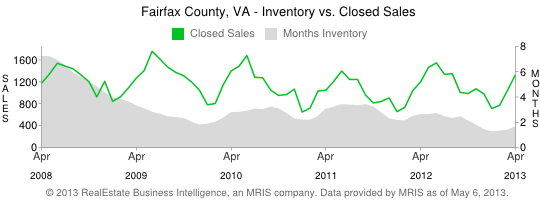
As the chart shows, our inventory here in Fairfax County remains stubbornly low throughout April, and into May.  ImageWith an average sold price of $522,960 in Fairfax County, we are 1% down from last month, but we are 10.55% up over last year at this time.  Further analysis shows that new listings have risen sharply over the last few months, pretty much in line with the pattern of the last five years.  

ImageAs you’ll notice, it’s the same story in both Arlington and Alexandriarises in average sales price ($609,729 in Arlington–up 2.1% over last month–and $536,868 in Alexandria, a staggering 9.53% gain over last month alone!) — and record-low inventories (both holding fast at just about seven weeks).  Again, I am hearing rumblings of clients Imagetossing out Financing and Home Inspection Contingencies just to stay competitive.  (Take a look at last month’s post for clarification on what that means.)

It’s nuts!  The market here is roaring.  Homeowners without a motivation to sell are beginning to notice that it’s their market right now, and are waiting to put their home on the market (despite sub-60-day Day On Market stats), if they’ll sell at all.  For those who are up against a deadline or other circumstance, a well-priced home in great shape and which shows well will likely be gone in no more than two weeks.  The homes in the best locations are still being snapped up before they even hit the market, and homebuyers are even getting creative in the face of defeat and frustration.  (Click the link for a story about how.)     

Thanks again for taking the time to read this…it is fantastic to watch a real, live, breathing organism (the market) and all of its parts intermingling and at work.  Here is a link to the site that compiles the research, if you happen to be interested.

As always, don’t keep me a secret.  If you happen to notice someone mention that they are in need of help buying or selling their home, pick up the phone and call me at 630.306.3537 immediately so we can discuss how you can help us meet.  If you are sitting there wondering, “Who’s this Jeff guy?” you can check out my other blog over at The Pen IS Mightier, where you will find all kinds of musings and opinions.  Hey, you never know what we might have in common!

Until next time, Happy Home Hunting!